

What connects you to the cards when you're not in the room
In the tarot tradition, a reading doesn't depend on the querent touching the deck. It depends on intention. A question has a direction, and the reader shuffles while holding it in mind. That's true whether you ask across a table or type your question into a form: either way, your words and your intent set what the cards answer.
The High Priestess sits between the black pillar and the white one, a veil of pomegranates behind her, a half-hidden scroll in her lap. She's the card of knowing that doesn't come through the five senses, and she doesn't need you in the room to do her work. Distance in miles has nothing to do with it. What counts is a clear question and a reader's undivided attention.
Readings by post are an old tradition
Working at a distance didn't start with the internet. Astrologers have cast charts for centuries for people they never met, working from a birth date, time and place sent by letter. Card readers took questions by post, and esoteric columns in twentieth-century magazines answered readers' letters.
An email and a private link are just the newest kind of envelope. The principle hasn't changed: a question in your own words, cards laid by someone focused on it, and an answer you can keep and return to.
What the reader does when they can't see you
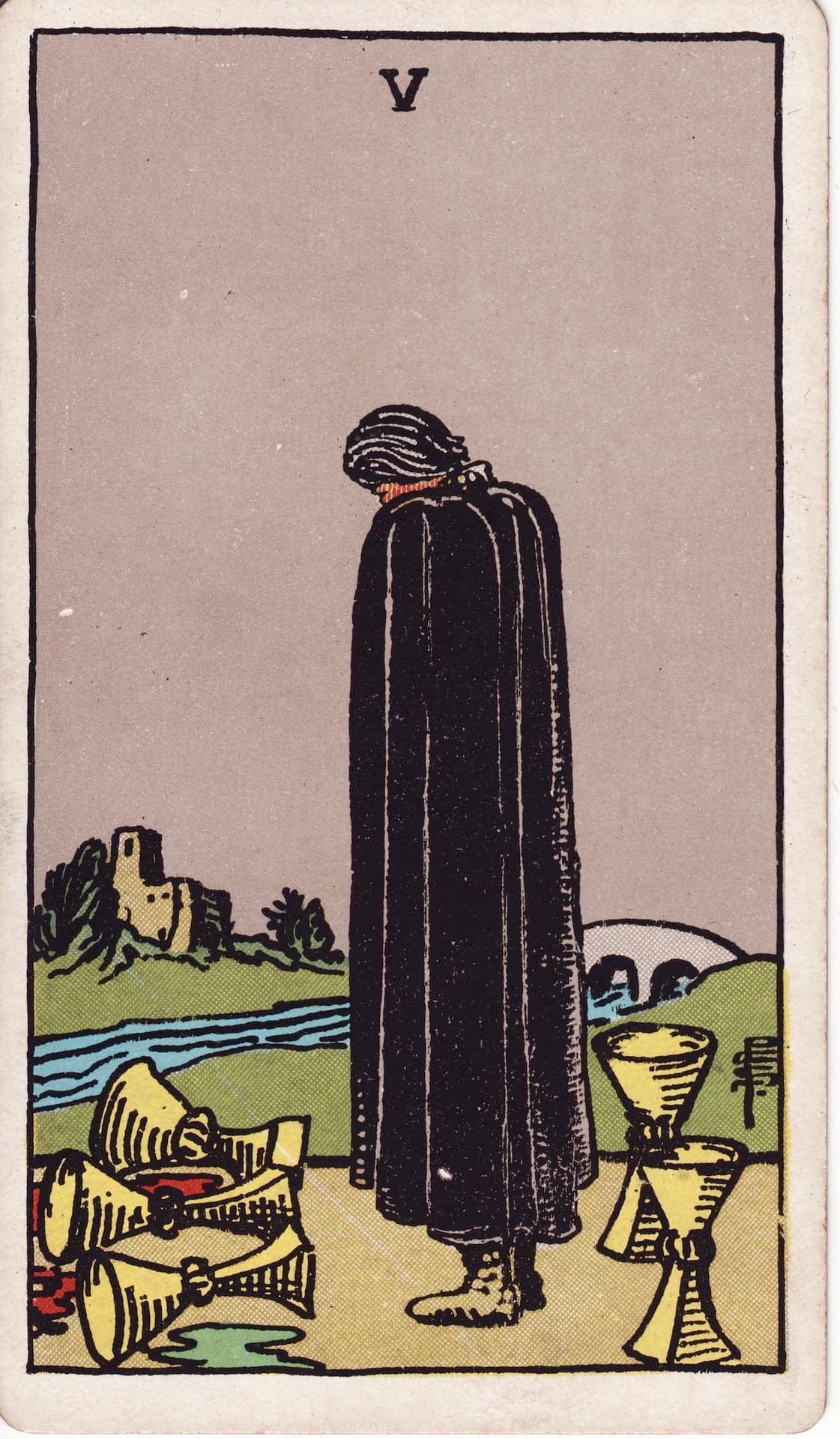
In a remote reading your question is the only anchor, so it gets read carefully, sometimes several times, before the deck is picked up. The context you add doesn't feed the reader an answer. It tells them what world the cards are speaking into. The Five of Cups, a cloaked figure mourning three spilled cups while two still stand behind him, means one thing in a question about a breakup and another about a job offer that fell through. The grief is the same shape, but what those two standing cups represent is completely different.
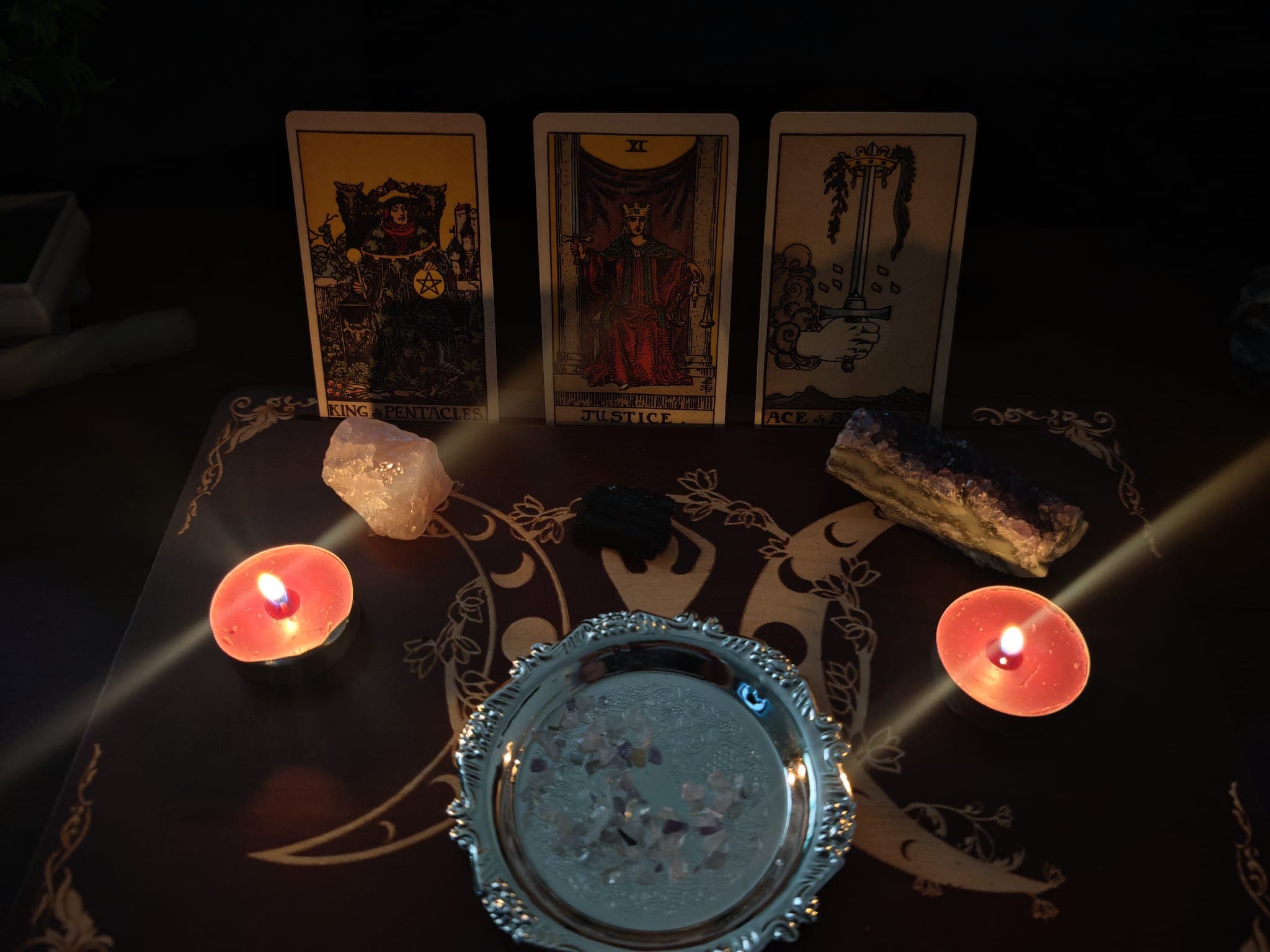
Then comes quiet and the shuffle. For me that's by candlelight, at a table set up for card work (the details are in online tarot with real cards). The focus is complete, because nobody's watching the clock and nobody's waiting on the other end of a call.
Where a written reading has the edge
Across a table, a reader sees your face. That can help, but it's also a trap: it's easy to start reading reactions instead of cards. A written remote reading doesn't have that temptation. The interpretation comes from what's on the table and from your question, not from the way you flinched at the first card.
The second advantage is time. In writing, every word can be weighed. The reader can go back over the spread and work out how the Hanged Man, suspended and patient, slows down the Eight of Wands flying in next to him. And you get a text you can reread a week later, once the situation has moved on.
Live readings have their strengths, especially when you want a conversation. But as far as the accuracy of the interpretation goes, distance doesn't weaken it.
Questions that suit online readings best
A remote reading gives you the most when the question can be written clearly and the situation has a few layers.
- Decisions: “What should I weigh up when choosing between the offer abroad and staying where I am?”
- Relationship dynamics: “What's going on between me and J. since our last argument, and what step makes sense now?”
- Feeling stuck: “What's holding me back in my job search?”
- Direction for the coming months: “What should I focus on over the next three months?”
- A simple closed question: “Should I send this message this week?” One card is enough here.
Questions that read poorly, wherever you are
Some questions get murky answers whether they're asked at a table or online. That's about craft, not the medium.
- Exact dates. Tarot shows dynamics and direction, and it has little patience for calendars.
- What someone else is thinking “right now”. The cards describe the relationship from your side of it.
- The same question asked over and over. A second and third spread on the same issue in one week blur the first rather than clarify it.
- Several questions in one sentence: “Will he come back and should I change jobs?” The cards will answer one of them, and you won't know which.
How to prepare for a reading at a distance
Since your question is the only bridge between you and the deck, it's worth a few minutes. How to ask tarot a question has more examples.
- Write the question in one sentence. If it won't fit in one, it's probably two questions.
- Add three or four sentences of context: what's happening, since when, what's already been tried. You don't need the whole story, just the backdrop.
- Don't write in the answer you want. “When will he finally realise he loves me?” narrows the cards to one road. Better: “What is he bringing to this relationship, and what can I do about it?”
- Take a moment of intention when you send it. Some people light a candle, some sit quietly and repeat the question in their head. For questions about fresh starts, many practitioners like to ask during the waxing moon. More in moon phases and rituals.
- Don't ask about the same thing elsewhere while you wait. Let the cards speak.
When your reading arrives
Read it through once, then go back to the photo of the cards. Notice which card catches your eye before you read its description. It's often the one with the most to say.
If something is unclear, the 3-Card and Love Clarity readings give you 48 hours for one follow-up question at no extra cost. The best follow-ups grow out of the reading itself, something like “what could help with what the middle card showed?”, rather than opening a brand new topic.
Frequently asked questions
Does online tarot work?
Yes. In the tarot tradition, what makes a reading is the question, the intention and the reader's focus, not the querent's physical presence. Cards laid at a distance answer a written question just as they do across a table.
Does a tarot reader need to see me or have my photo?
No. A clearly worded question and a little context are enough. Not seeing you even has an advantage: the interpretation rests on the cards rather than on your reactions.
Are online tarot readings less accurate than in person?
Distance doesn't weaken the interpretation. Accuracy depends on the quality of the question and on how well the reader connects the cards to each other and to your situation. A written reading gives the reader time to think the spread through and gives you something to reread.
What questions are best for an online tarot reading?
Questions about decisions, relationship dynamics, feeling stuck and direction for the coming months work best. Questions about exact dates or what someone is thinking at this moment work poorly.
How should I prepare for an online tarot reading?
Write your question in one sentence, add three or four sentences of context and avoid spelling out the answer you want. A moment of focus when you send it, such as lighting a candle, helps set your intention.
Personal reading
Ask your question from wherever you are
The 3-Card Reading, 22 EUR, is three cards laid on a physical deck for your question, a photo of the spread, a written interpretation on your private page and one follow-up question within 48 hours.
Order a 3-Card Reading →