The element of air: what Swords are about
Swords belong to air. In the Golden Dawn system that shaped the deck Arthur Edward Waite and Pamela Colman Smith produced in 1909, air governs the mind, speech, judgement and anything that can be named, divided and weighed. A sword has two edges. The blade that wounds is the same blade that cuts you free of the net. That is why this suit is never simply bad. It is sharp, which is a different thing.
The air signs are Gemini, Libra and Aquarius. Libra gives the suit its hunger for fairness and balance, Aquarius its cool distance and thinking in principles, Gemini its speed and curiosity along with scattered attention and racing thoughts. In the old theory of the four humours, air is the sanguine temperament: light, sociable, changeable. The cards tend to show its shadow side, too much analysis, too much worry, words that leave the mouth too fast.
In the common timing convention (Wands spring, Cups summer, Swords autumn, Pentacles winter), Swords point to autumn, the season of thin cold air and clearing out. Many readers prefer to time events by the decan of the specific card instead, which we cover below. On the RWS cards you can literally see the air: clouds, wind, birds, butterflies, bent trees. Always read the sky on a Swords card. It tells you the state of the figure's mind better than the face does.
In Golden Dawn ritual the elemental weapon of air is the dagger, and the tarot sword is its counterpart. Some modern Wiccan lineages give the athame to fire and the wand to air, but the RWS deck follows the Golden Dawn order. If you work with the elements on an altar, the Ace of Swords suits intentions around clarity, study, a difficult conversation or cutting old cords. Incense, feathers and clear quartz belong to the same sphere.
All the Swords cards
Tap a thumbnail to jump to a card
A
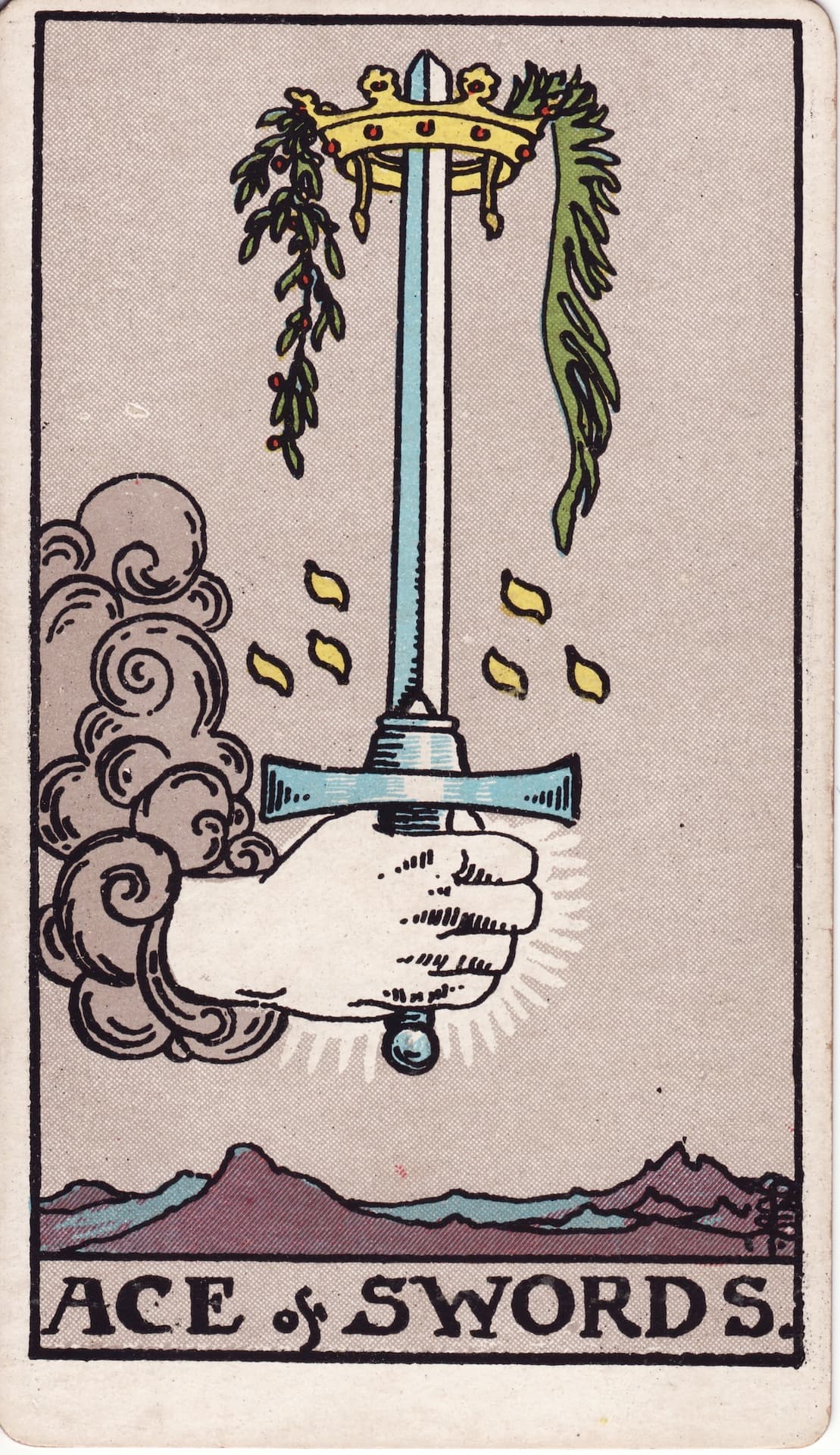
Ace of Swords
A hand from a cloud holds an upright sword topped with a crown, an olive branch and a palm hanging from it. This is a mental breakthrough, the truth cutting through confusion, a clean decision. In love it is an honest conversation; at work a fresh idea or a case won. Reversed, it leans toward muddled thinking, words used as weapons or a decision made too fast.
II
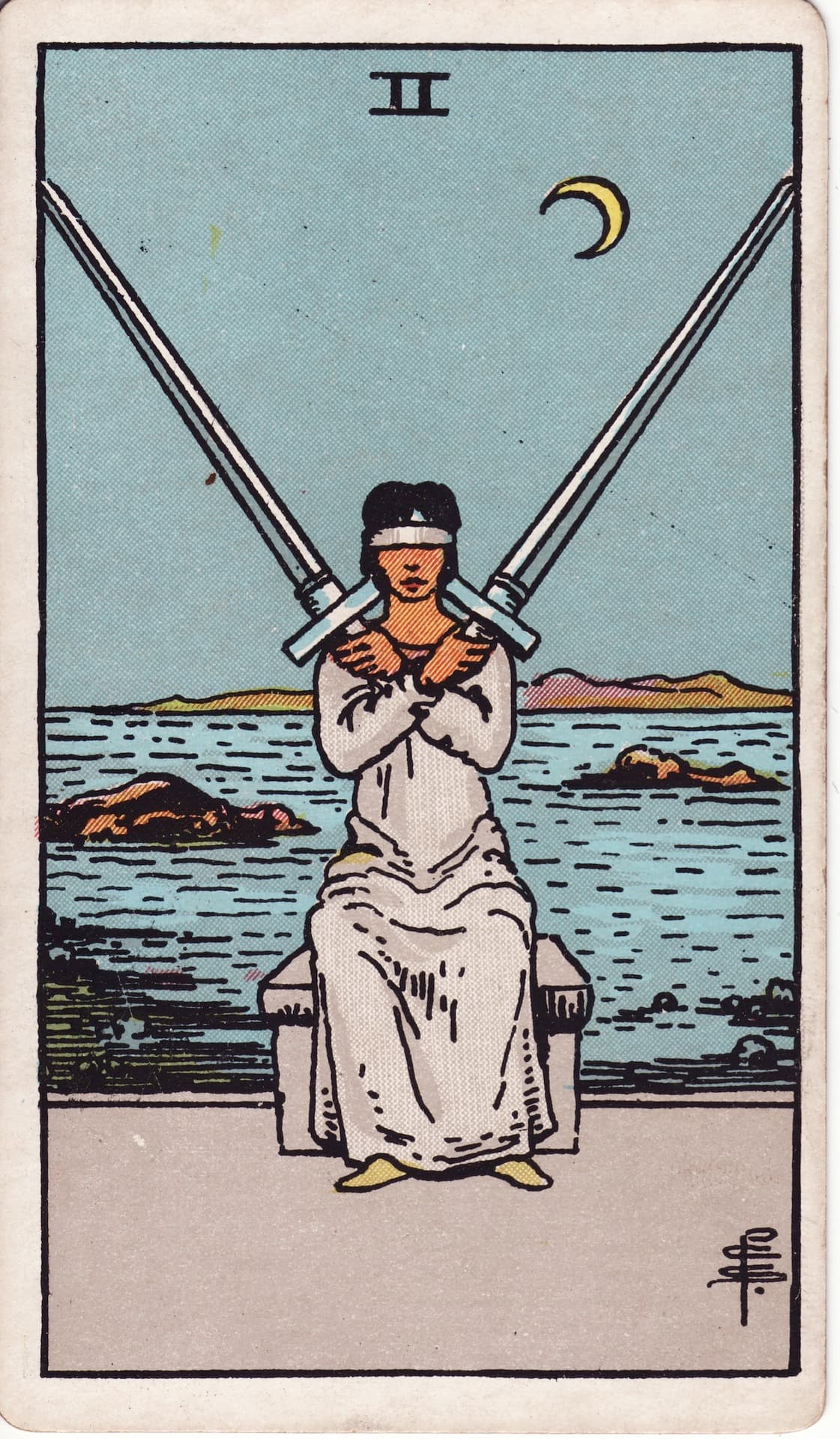
Two of Swords
A blindfolded woman holds two crossed swords, with a rocky sea and a crescent moon behind her. It means stalemate, truce and avoiding a choice because every option costs something. In love it is indecision or a frozen conflict; at work a decision kept on hold. Reversed, the blindfold usually slips: the truth comes out and the choice can no longer be dodged.
III
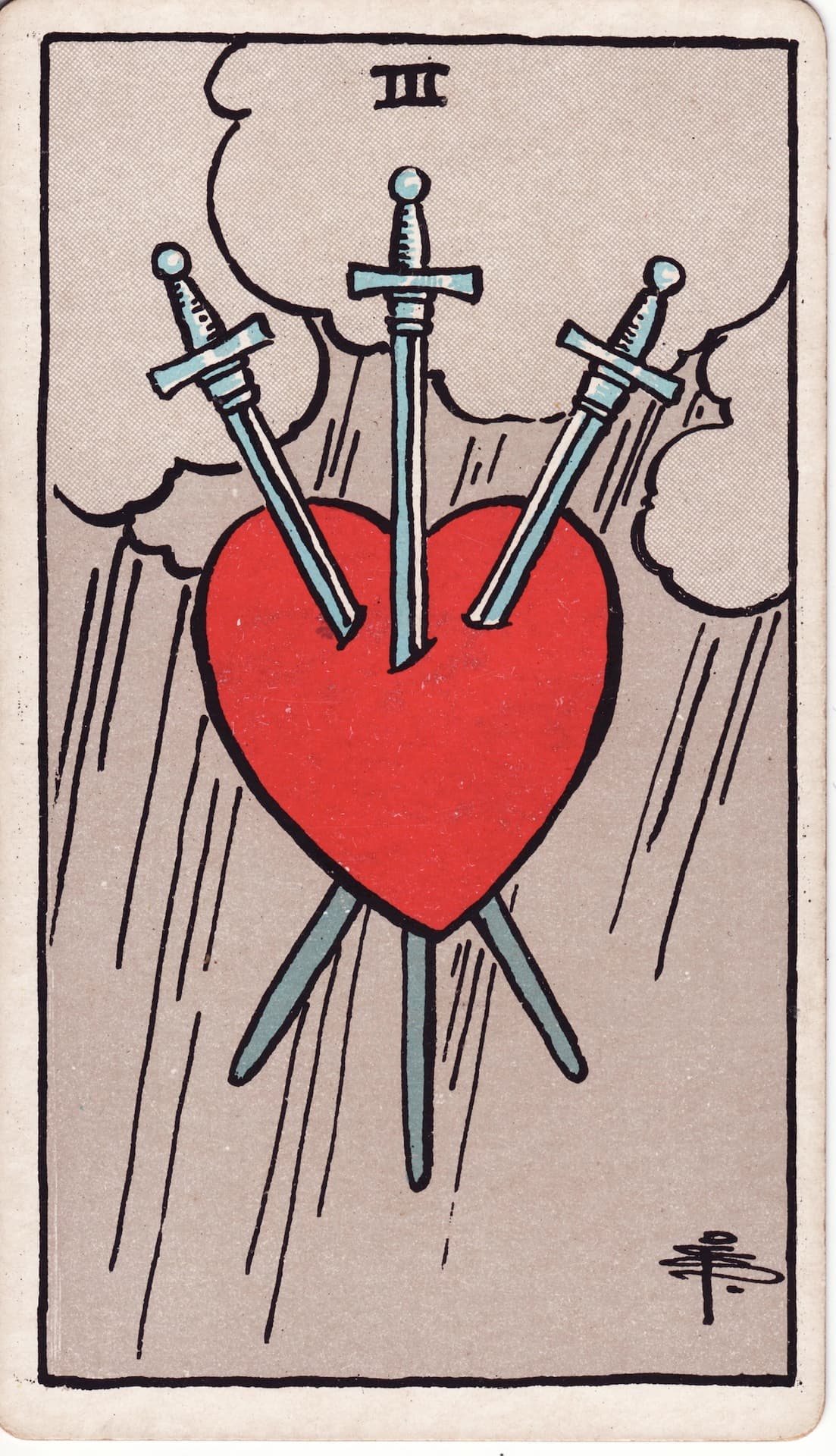
Three of Swords
A heart pierced by three swords against grey rain clouds is the best-known image of grief in tarot. It speaks of pain, disappointment and a truth that hurts but ends an illusion. In love it can be betrayal, separation or an old wound; at work, unwelcome news. Reversed, it points to healing, or to pain pushed down and left unspoken.
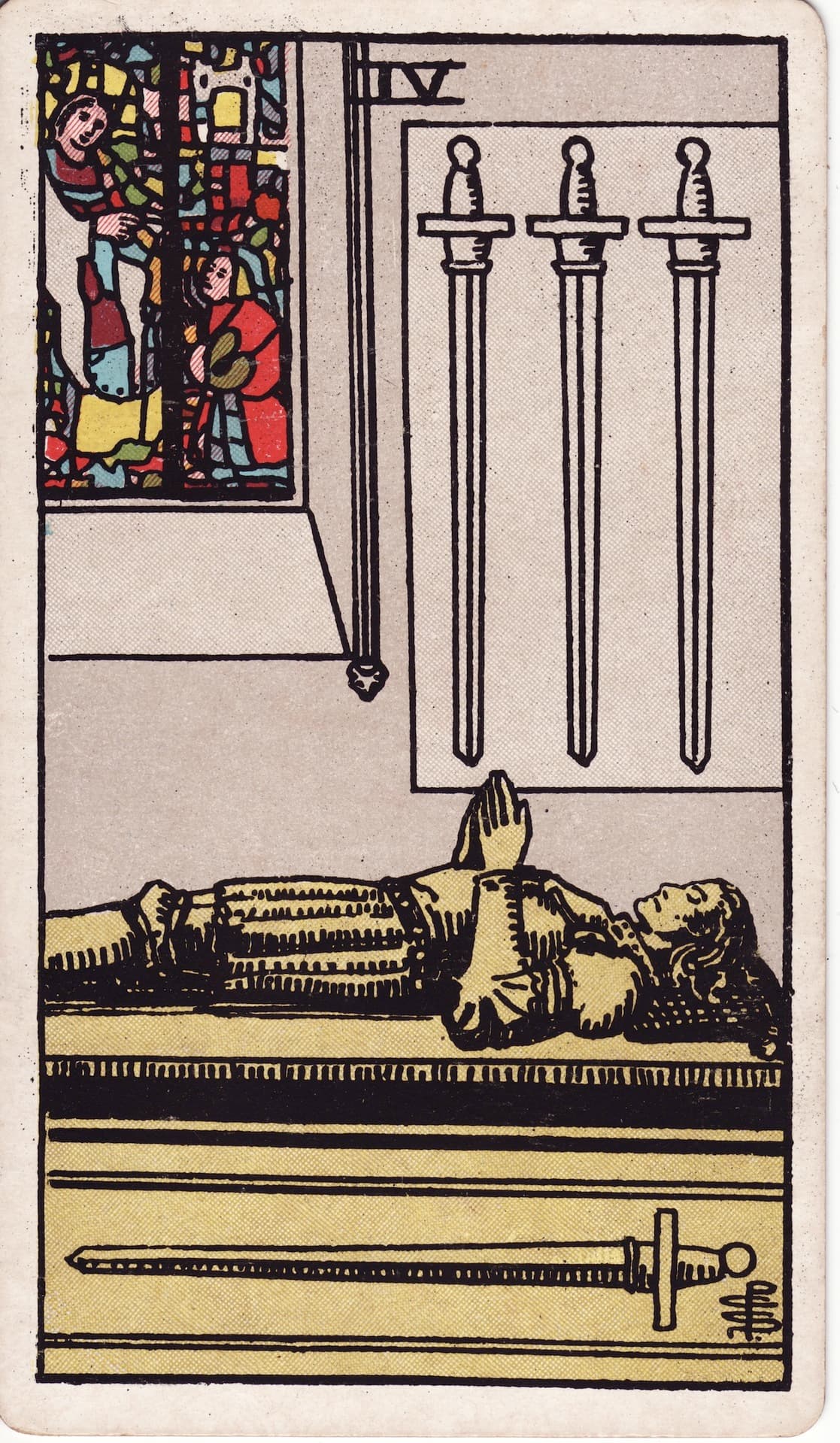
IV
Four of Swords
A knight's effigy lies on a tomb in a church, hands joined in prayer, three swords above him and one along the side of the tomb. This is rest, recovery and the quiet a mind needs. In love it is a pause in the relationship; at work leave or a slow period worth using well. Reversed, it points to burnout, returning to action too early or a standstill imposed from outside.
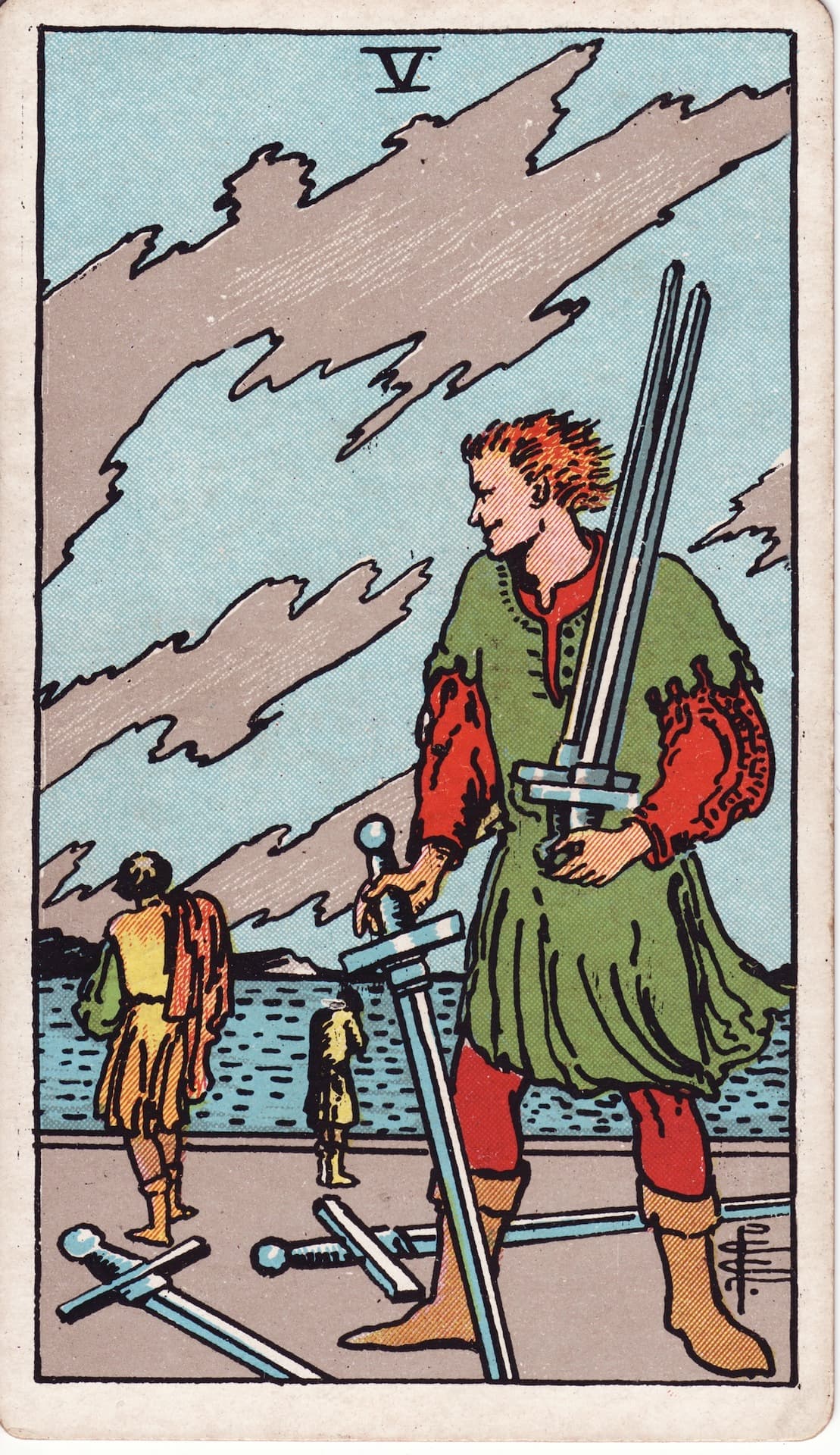
V
Five of Swords
A smirking man gathers up swords while two defeated figures walk off toward the water under a jagged sky. This is the conflict where victory tastes sour, and the question of whether being right is worth the price. In love it is a fight that leaves a chill; at work, dirty competition. Reversed, it often shows a wish to make peace, or old resentments coming back.
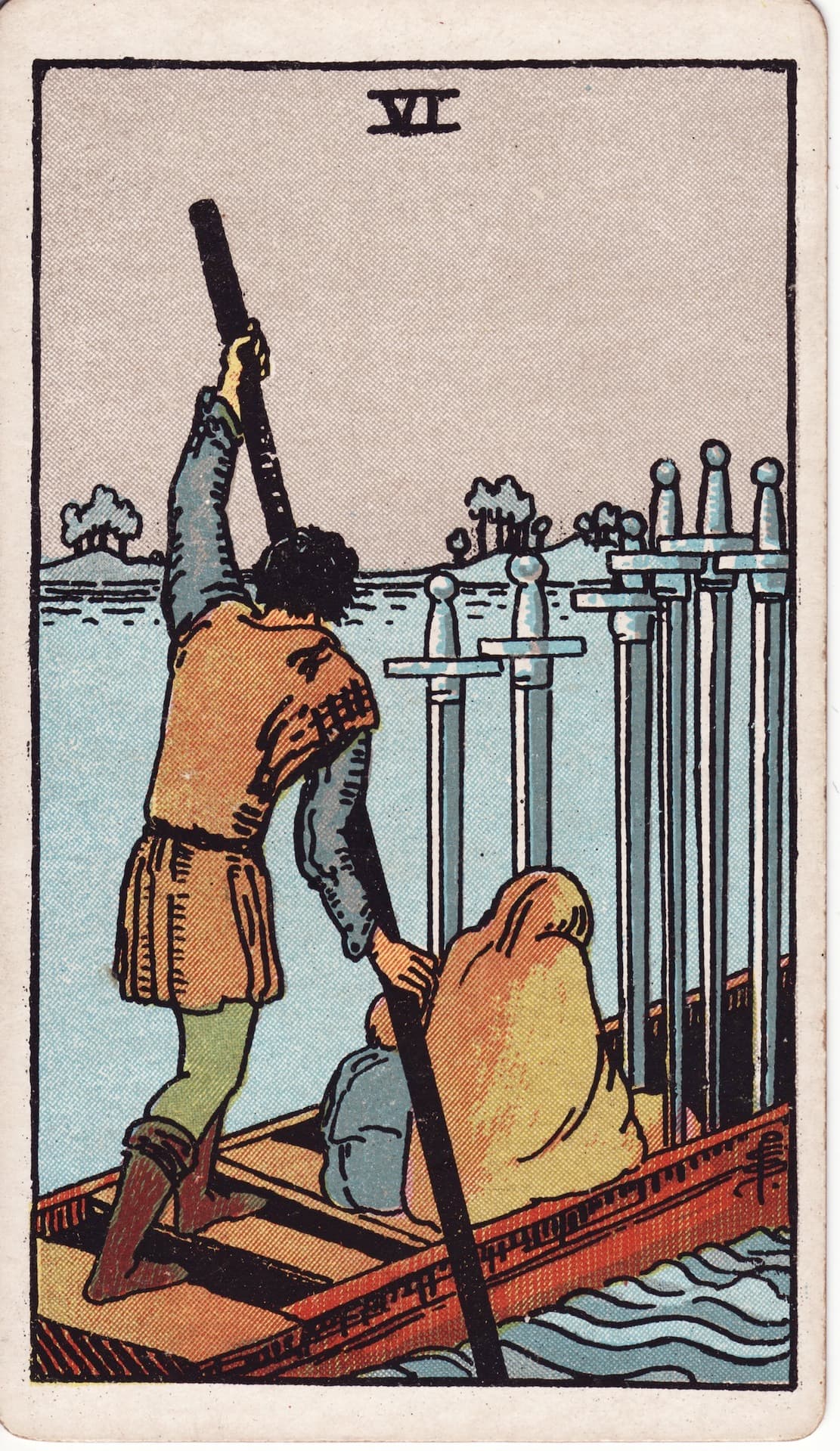
VI
Six of Swords
A ferryman poles a boat carrying a hooded woman and a child, the water rough on one side and smooth on the other. It marks a passage from hard times to calmer ones, a move, a shift in perspective, distance from conflict. In love it is leaving a stormy phase behind; at work a change of team or place. Reversed, it suggests trouble letting go, unfinished business still riding in the boat.
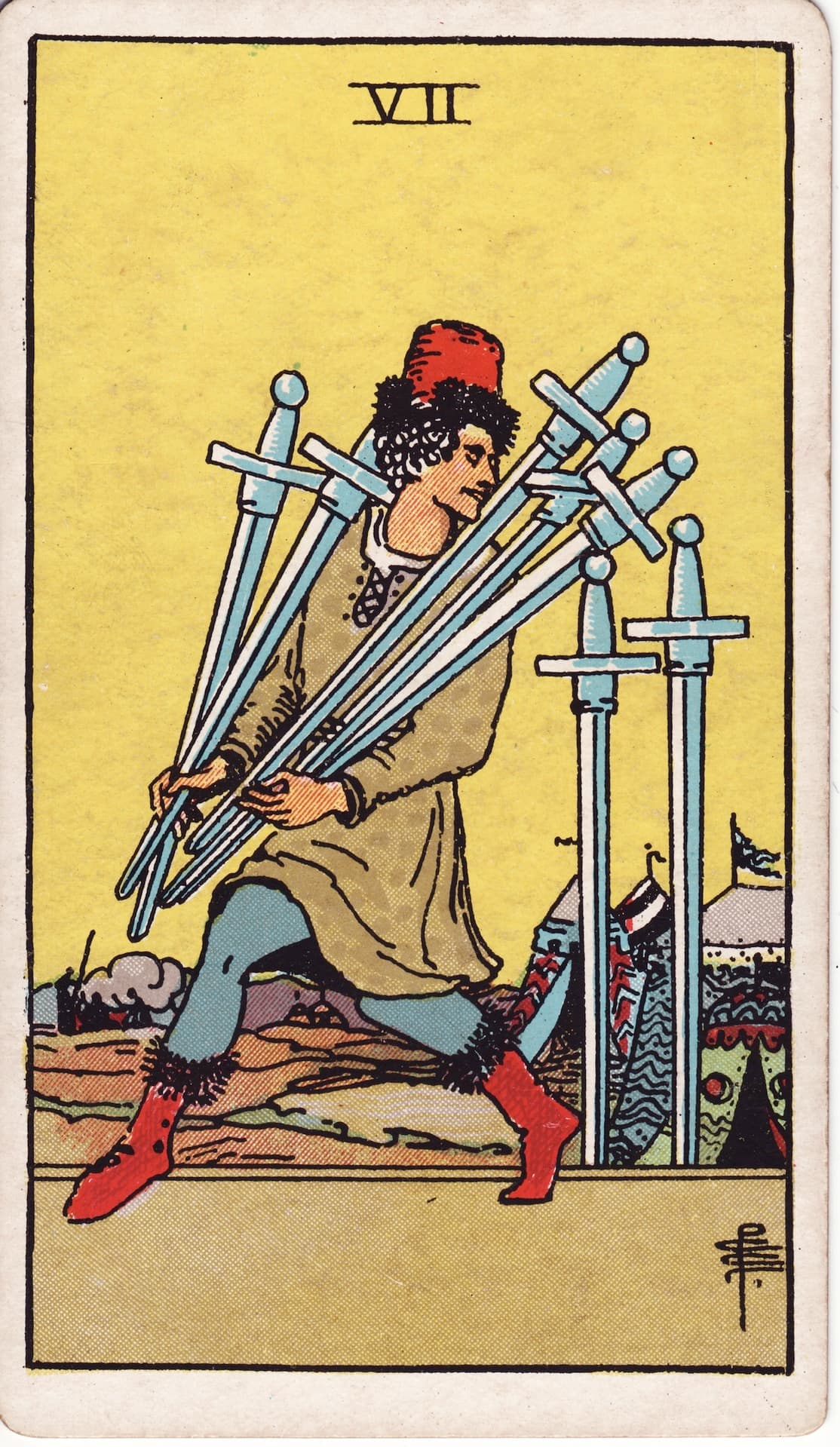
VII
Seven of Swords
A man tiptoes out of a camp with five swords, leaving two stuck in the ground and glancing back over his shoulder. It is strategy, cunning and going it alone, sometimes dishonesty or dodging confrontation. In love it points to secrets or playing both sides; at work to discretion and checking the fine print. Reversed, the secret often comes out, or conscience sends someone back to own up.
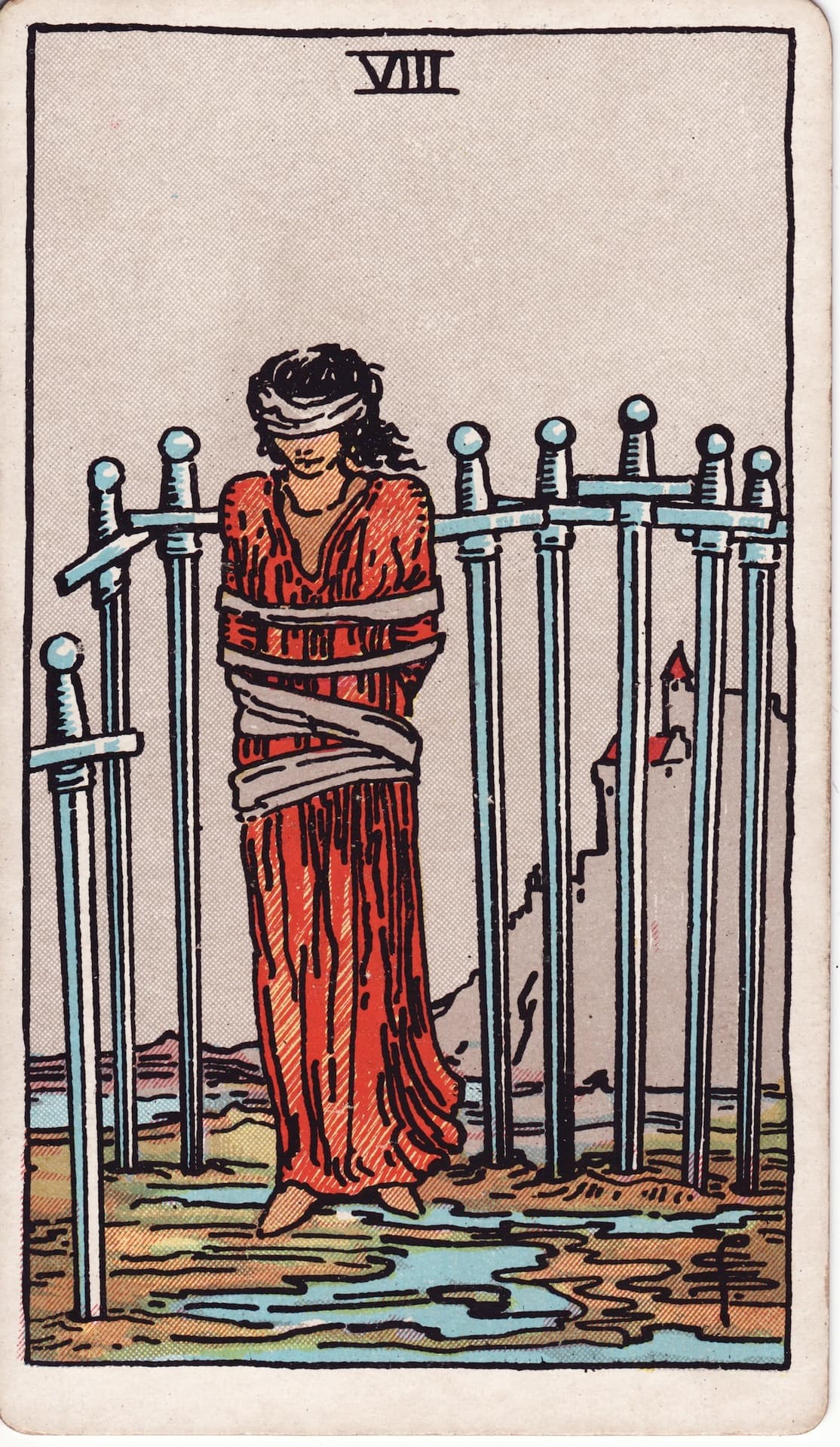
VIII
Eight of Swords
A bound, blindfolded woman stands among eight swords, yet her ropes are loose and the way ahead is open. This is the prison of belief: feeling there is no way out, when the trap lives more in the mind than in the situation. In love it is a relationship someone cannot see beyond; at work feeling stuck in a role. Reversed, it signals release, the blindfold off and the first step outside the circle.
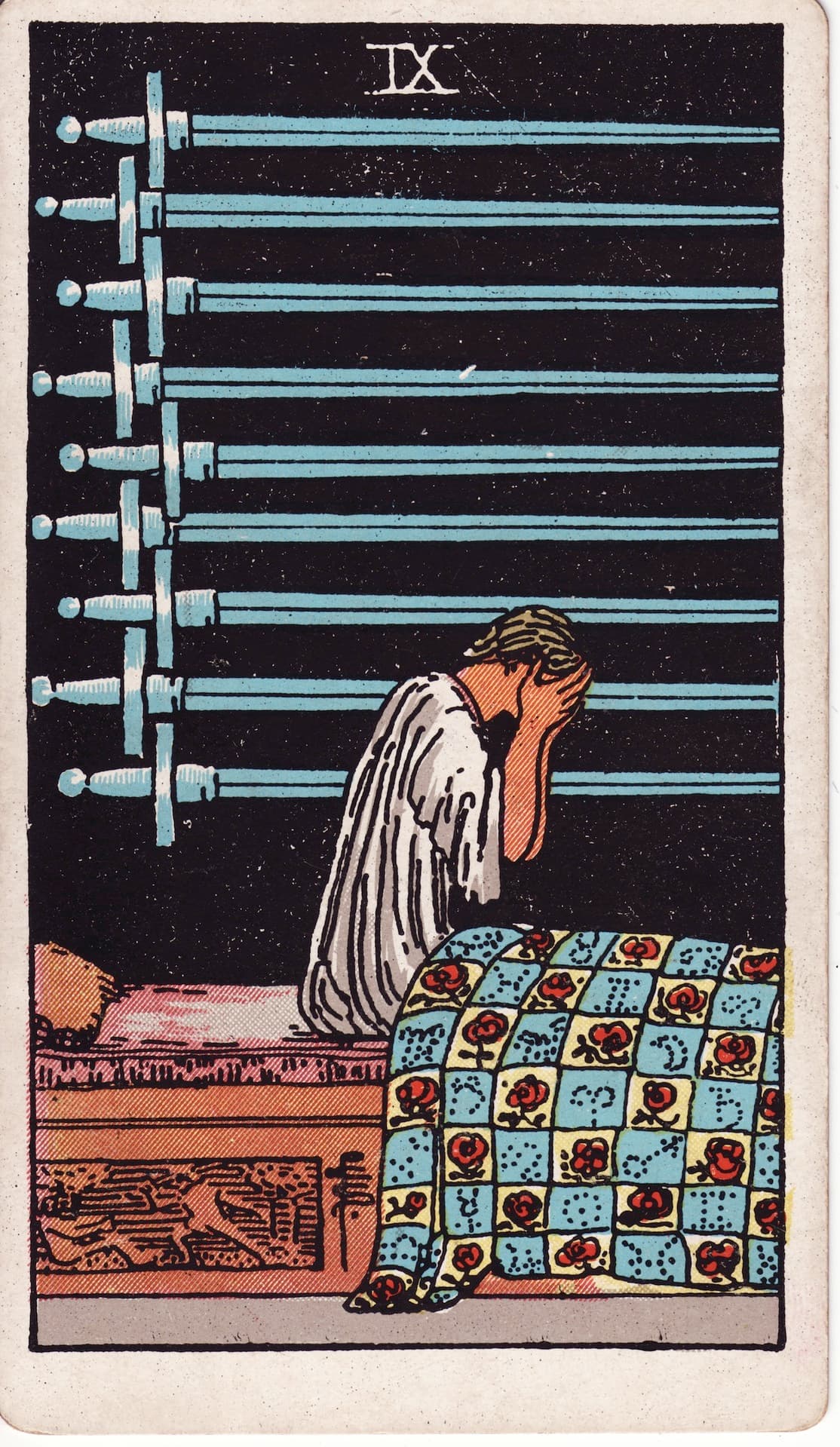
IX
Nine of Swords
A figure sits up in bed with her face in her hands, nine swords on the black wall and roses and planetary glyphs on the quilt. This is the card of night fears, insomnia, guilt and thoughts louder than facts. In love it is worrying the relationship to pieces; at work stress that steals sleep. Reversed, the fear starts to ease and the problem is ready to be talked through with someone trusted.
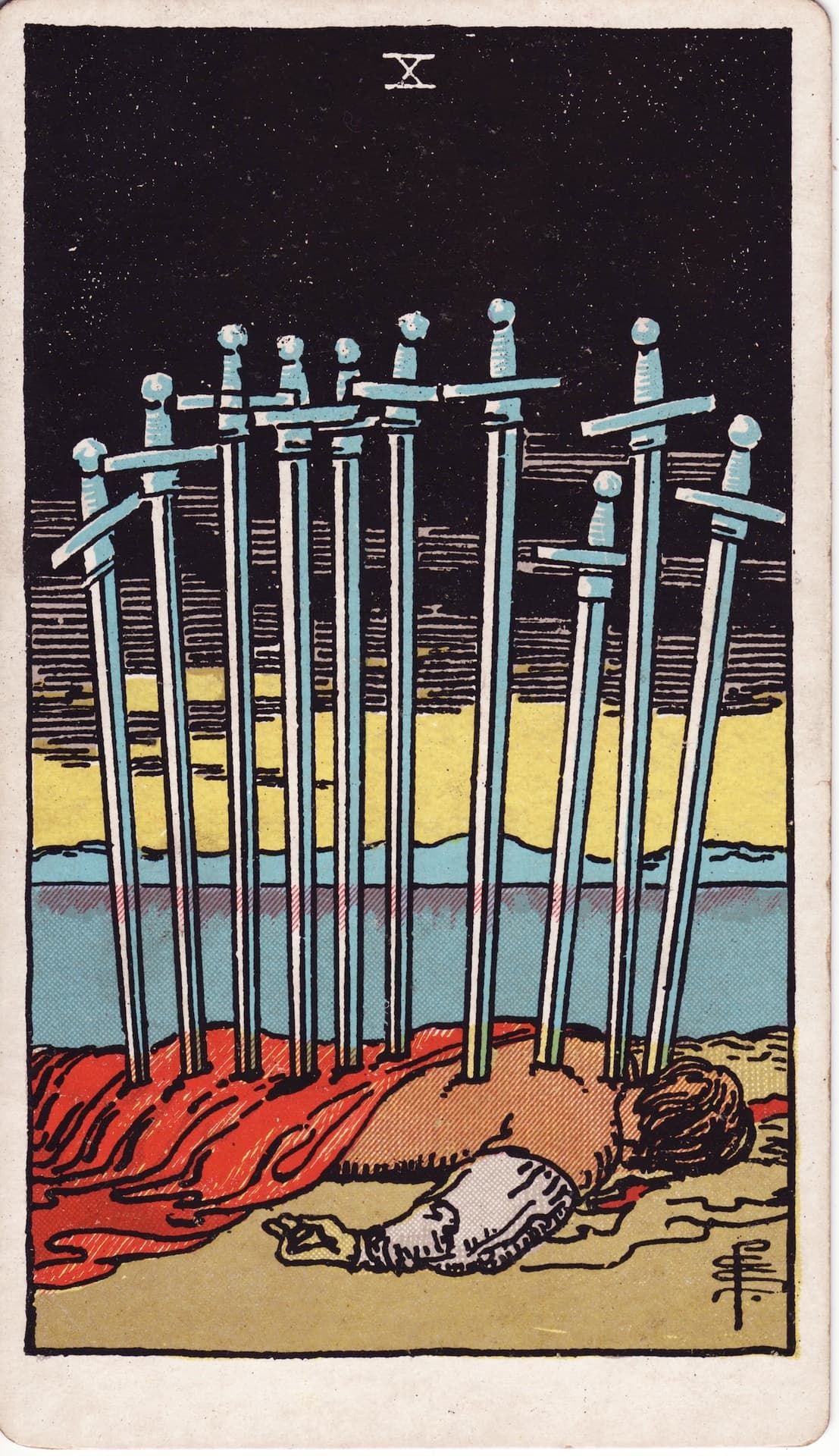
X
Ten of Swords
A man lies face down with ten swords in his back, but a golden dawn is breaking under the black sky and the water is calm. It is the end, rock bottom, a chapter closing after which things cannot get worse. In love a definite ending or a painful truth; at work a project collapsing to make room for the next. Reversed, it shows slowly getting back up, or dragging out an ending that has already happened.
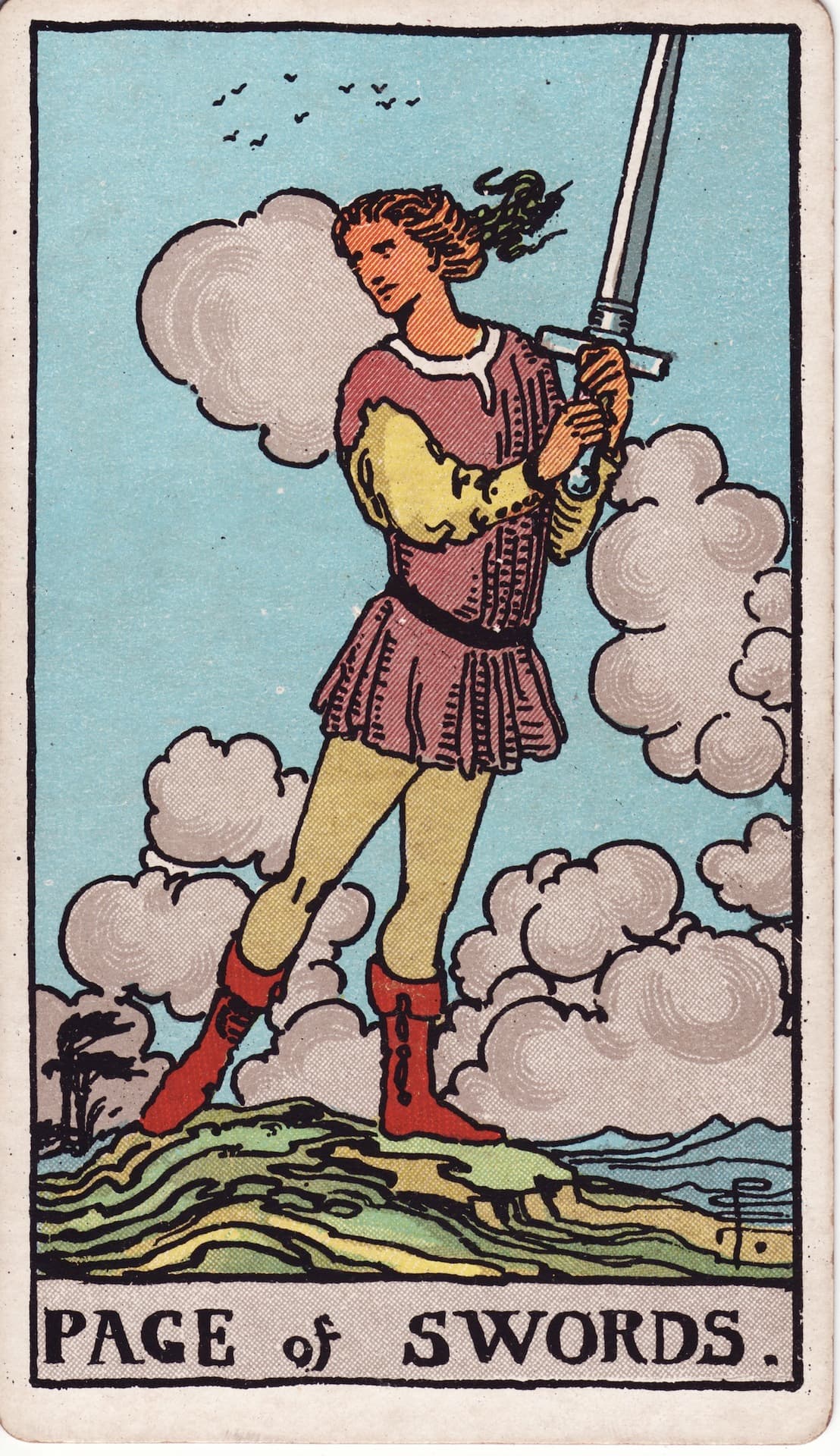
P
Page of Swords
A young figure stands on a hill gripping a sword in both hands, wind tearing at the clouds, glancing alertly over one shoulder. The Page is curiosity, study, gathering information, sometimes a message or a rumour. In love someone who asks a lot and watches closely; at work a new task that needs a sharp mind. Reversed, it leans toward nosiness, gossip or careless words.
Kn
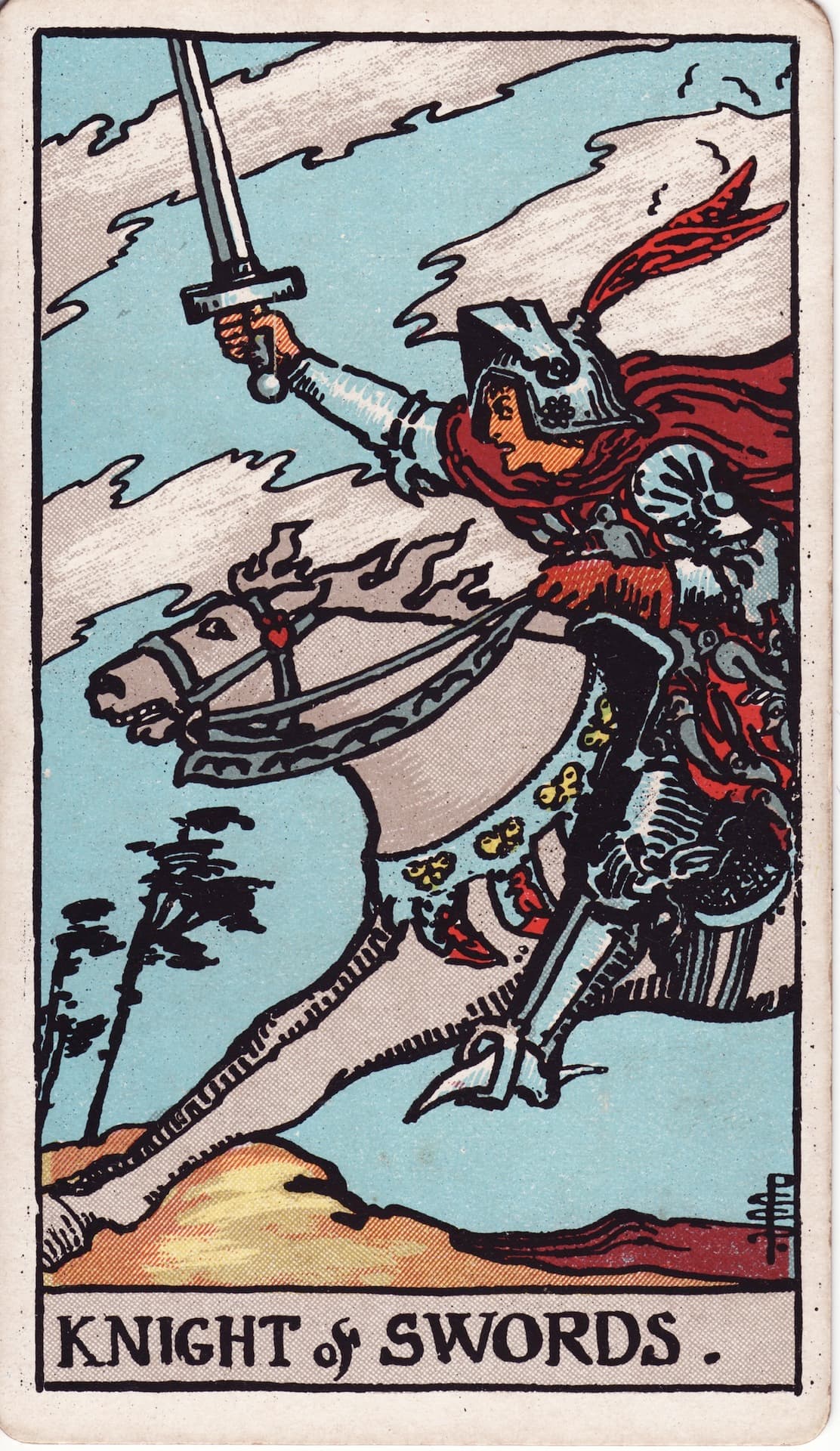
Knight of Swords
The Knight charges on a white horse straight into the wind, sword raised, trees bending, butterflies and birds on the harness. This is speed, drive, uncompromising truth and action without delay. In love someone intense and honest but impatient; at work a fast, decisive push. Reversed, it points to recklessness, conflict caused by tactlessness or energy scattering in every direction.
Q
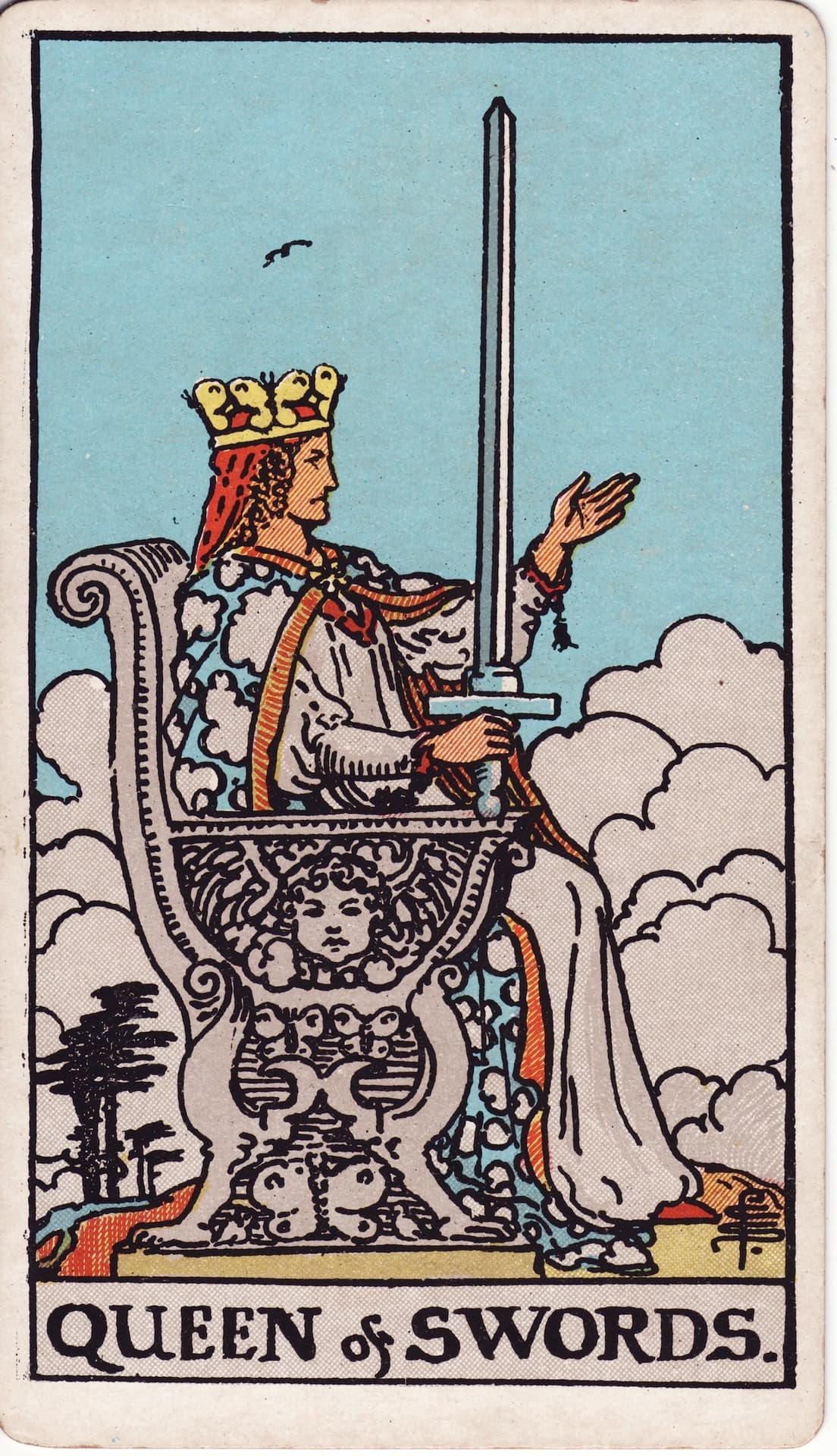
Queen of Swords
The Queen sits in profile holding an upright sword with her other hand extended, butterflies and a winged cherub's head on her throne and a single bird high above. This is clear judgement, independence, honesty and boundaries earned through experience. In love someone who loves with open eyes and cannot be manipulated; at work the adviser or editor who tells it straight. Reversed, she leans toward coldness, severity or bitterness over old wounds.
K
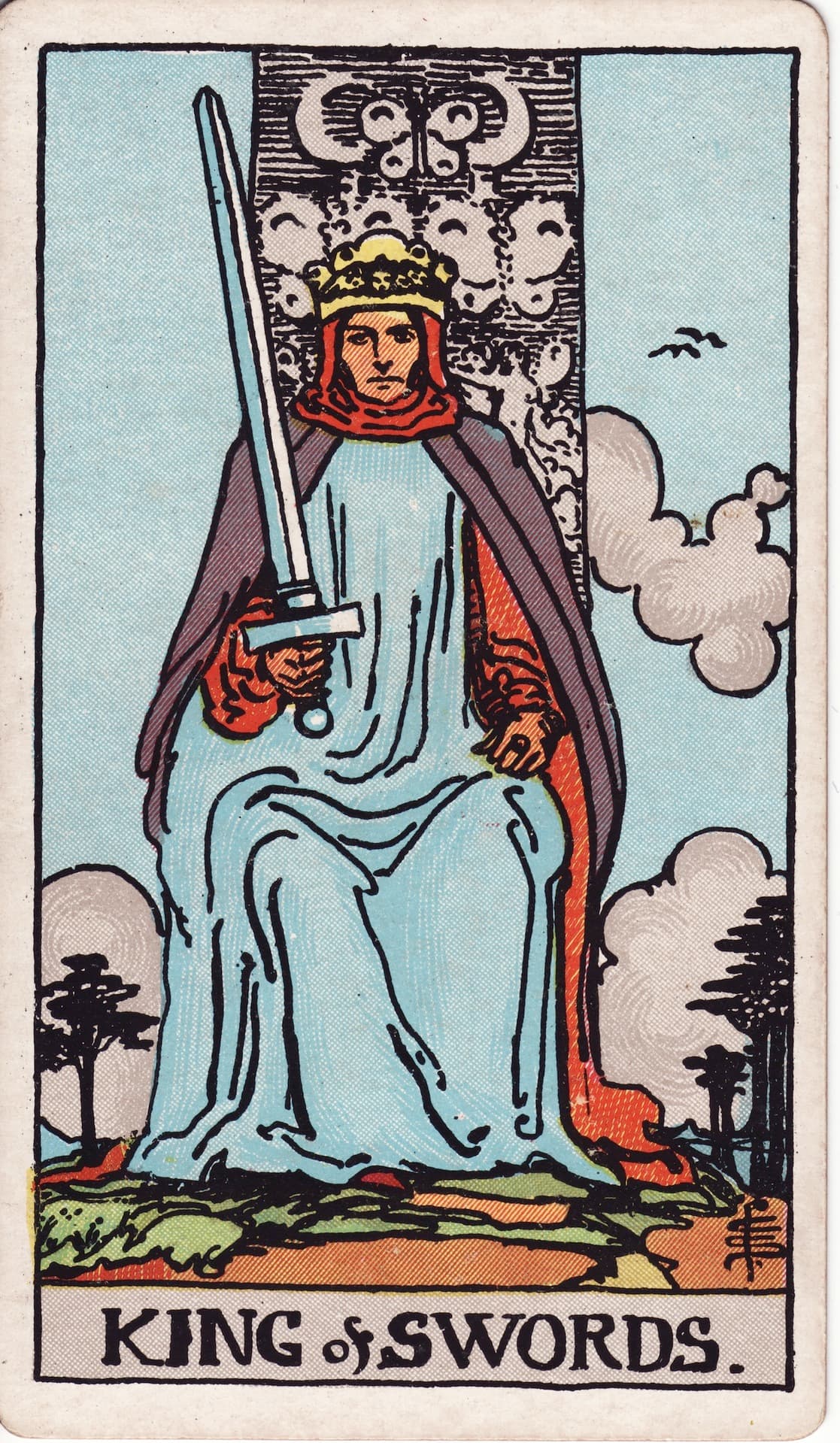
King of Swords
The King sits facing us, sword tilted slightly to the right, butterflies and crescent moons on his throne, trees and two birds behind him. This is intellectual authority, justice, ethics, decisions based on facts. In love a rational, loyal partner who is not very demonstrative; at work the lawyer, boss or expert. Reversed, he leans toward manipulation, cold control or using knowledge against people.
Ace to Ten: the numbers as a story of the mind
The pip cards of each suit tell a story, and the Swords story is about what we do with the truth. Pythagorean number symbolism is a good key: one is the seed, two the choice, three the first fruit, four the structure, five the crisis, six the repair, seven the test, eight movement or its paralysis, nine the peak, ten the end of the cycle.
- Ace: a flash of clarity. The thought that cuts through confusion, the truth said out loud.
- Two: stalemate. The mind refuses to choose because every option has a price.
- Three: the first fruit of truth, and it often stings. The moment you stop pretending nothing happened.
- Four: the pause. A mind needs silence to set itself upright again.
- Five: the fight where winning feels worse than losing.
- Six: the crossing to calmer water. Your thoughts come along in the boat, but you are no longer drowning in them.
- Seven: strategy, cunning, sometimes slipping away from a confrontation.
- Eight: the prison of belief. The ropes are loose and the path is open; only the blindfold says otherwise.
- Nine: the peak of anxiety, the night when thoughts are louder than facts.
- Ten: rock bottom and the end. It cannot get worse, and dawn is already on the horizon.
The Golden Dawn decans at a glance
The Golden Dawn gave every card from Two to Ten a ten-degree slice of the zodiac and a ruling planet. For Swords those slices fall in Libra, Aquarius and Gemini, in that order. These are not decoration: they explain why each card feels the way it does. The Ace sits outside the decans as the Root of the Powers of Air, the element in its raw form.
Decans earn their keep in two places: timing questions and cards that refuse to make sense in a spread. When the question is "when?", the Three of Swords can point to roughly October 3 to 12, when the Sun moves through its decan. The Nine of Swords points to early June, the Five to the last ten days of January.
The planet also sets the tone. The Six of Swords under Mercury is good news for study, paperwork, translation, anything that moves knowledge from one place to another. The Four under Jupiter is rest that heals, not escape. The Nine, Mars in Gemini, says it plainly: the mind is attacking itself, and the battle is fought in sentences you repeat to yourself at night. This is how a reading moves from generic to specific.
- Two: Moon in Libra, Lord of Peace Restored. A truce held together by emotional suspension.
- Three: Saturn in Libra, Lord of Sorrow. Saturn is exalted in Libra, so this is grief that teaches form and boundaries.
- Four: Jupiter in Libra, Lord of Rest from Strife. A generous break you are meant to accept.
- Five: Venus in Aquarius, Lord of Defeat. A cold Venus that trades warmth for being right.
- Six: Mercury in Aquarius, Lord of Earned Success (Crowley's Science). The mind finds the answer.
- Seven: Moon in Aquarius, Lord of Unstable Effort. A well-meant plan with nothing solid under it.
- Eight: Jupiter in Gemini, Lord of Shortened Force. Too many options, too little commitment.
- Nine: Mars in Gemini, Lord of Despair and Cruelty. Aggression turned inward, into thought.
- Ten: Sun in Gemini, Lord of Ruin. The light only arrives once the old mental structure falls.
Swords court cards: people or energies?
Court cards can be read as actual people around the querent, or as attitudes the querent is taking on. With Swords both approaches pay off, because the mind is both a tool and a personality. In the Golden Dawn scheme that many RWS readers follow, the Page is earth of air, the Knight fire of air, the Queen water of air and the King air of air. Some modern readers swap the Knight and King. As astrological shorthand, the Queen of Swords links to Libra, the King to Aquarius and the Knight to Gemini.
As people: the Page is someone young or new to the field, curious, watchful, sometimes nosy. The Knight acts fast and speaks before thinking, a brilliant advocate and a terrible diplomat. The Queen is sharp and grown-up, knows exactly what she will not tolerate, and has often been through a loss that burned away her patience for games. The King is an intellectual authority: the lawyer, the doctor, the manager who decides on evidence rather than on who he likes.
As energies: the Page says gather information, the Knight says cut now, the Queen says name the boundary, the King says judge fairly. When the King of Swords turns up for a partner, ask two questions, not one. Who is this person, and is this a relationship where the head does all the talking while the heart stays quiet? The same card can describe the other person and what the situation asks of the querent.
Swords in love readings
In love, Swords do not automatically mean a breakup. They speak about communication, about what has or has not been said, and about the beliefs each person brings into the relationship. When they dominate a relationship spread, the connection is living more in the head than in the heart and body. The opposite pole is the suit of feeling, so read them alongside the Cups: the ratio between the two sets the tone of the whole reading.
The Three of Swords in a past position often shows a wound still being carried: betrayal, disappointment, words that went too deep. In the present, it is the moment of truth that hurts but ends the guessing. The Two of Swords is the classic "I don't know what I want", a blindfold worn to avoid seeing the signs. The Queen of Swords as the partner describes someone perceptive, honest to the point of bluntness, who loves fully but cannot be played.
An example. The question: "Is this new person being straight with me?" The cards: Seven of Swords, Page of Swords, Ace of Swords. Something is being held back, there is information circulating that the querent has not seen yet, and a clear conversation will bring it into the open. The usual advice from Swords in love is the same every time: say it plainly, listen plainly, and do not fill the gaps with your own story.
Swords in career and money readings
At work, Swords are allies. This is the suit of analysts, lawyers, developers, editors, negotiators, anyone who works with words and logic. The Ace of Swords in a career question is a breakthrough idea or a decision that finally lands. The Six is a move to a calmer role or field. The King is a position that demands judgement and accountability.
The harder cards have concrete content too. The Five of Swords warns against winning the argument and losing the team. The Seven says read the contract and check people who promise too much, though it can also be clever strategy when you need to take what is yours and leave quietly. The Eight describes feeling trapped in a job, a trap held together partly by the belief that nobody else would hire you.
Swords say little about the actual figures; that is the job of the Pentacles. They speak about financial decisions instead. The Two is a choice postponed for months, the Four a good moment for a calm budget review, the Nine lying awake over a debt that looks far less frightening on paper than it does at 3 a.m. An advice-position example for "Should I pitch my idea to management?": Knight of Swords. Go, and go soon, but walk in with the numbers ready, because this Knight wins on speed and loses on sloppiness.
When Swords dominate the spread
When five or more Swords land in a ten-card spread, the heart of the matter is not in events but in the mind. Readers usually take it one of three ways, and the rest of the layout tells you which:
- Overthinking: the querent has analysed the situation so hard they have stopped feeling it.
- A communication problem: everything breaks down over words, tone and what was left unsaid.
- A decision point: the truth is already known and is only waiting to be spoken.
- Lots of low cards (Ace to Four) mean the process is beginning; lots of high ones (Seven to Ten) mean it is peaking.
- Many Swords with no Pentacles suggest the matter is still theoretical. Many Swords with no Cups suggest feelings are being shut off so they do not interfere with thinking.
Swords combinations
A good rule of thumb: the Major Arcana set the weight of the theme, and Swords show how the mind responds to it. Some pairings that come up often:
- Three of Swords + Star: grief followed by relief. The wound starts to close.
- Ten of Swords + Death: an ending confirmed twice. Nothing left to save, plenty to start.
- Nine of Swords + Moon: fear fed by imagination, restless dreams, worries larger than the facts.
- Ace of Swords + Justice: a contract, an official matter, a verdict. The truth comes out.
- Two of Swords + Lovers: a choice between two people or paths, left undecided for too long.
- Seven of Swords + Page of Swords: gossip, eavesdropping, information moving behind your back.
- Four of Swords + Hermit: a stretch of solitude and recovery. Put the phone in a drawer.
- Knight of Swords + Tower: a sudden confrontation and words that cannot be taken back.
Reading Swords maturely, not fearfully
The most common mistake is reading Swords literally: the Ten is disaster, the Three is betrayal, end of story. Look at the pictures instead. On the Nine, the swords hang on the wall and pierce no one, and the quilt is covered in roses and planetary glyphs. The suffering is happening in the mind. On the Ten, a golden dawn rises under the black sky, the water is still, and the fallen man's right hand forms a blessing, the same gesture the Hierophant makes.
A mature reading asks one question: what truth is trying to get through here? Swords rarely bring an event out of nowhere; they usually name something already under way. Read them like a friend who tells you the uncomfortable thing because they care. Reversed Swords often release the pressure or show it working below the surface, which we go into in the guide to reversed tarot cards.
Frequently asked questions
What does the Three of Swords mean in tarot?
The Three of Swords is the card of heartbreak and disappointment: a heart pierced by three blades in the rain. It usually describes a truth that hurts but ends an illusion, such as betrayal, a breakup or bad news. In a past position it shows a wound still being carried, and next to the Star or Temperance it points to healing.
Is the Ten of Swords a bad card?
The Ten of Swords means an ending and rock bottom, but not literal catastrophe. On the card a dawn rises under the black sky and the water is calm: a chapter has closed and it cannot get any worse. In a reading it usually says it is time to stop trying to save something that is already over.
What zodiac signs are associated with the suit of Swords?
Swords are the air suit, so they connect to Gemini, Libra and Aquarius. In the Golden Dawn system the Two, Three and Four belong to Libra, the Five, Six and Seven to Aquarius, and the Eight, Nine and Ten to Gemini. As shorthand, the Queen of Swords is Libra, the King Aquarius and the Knight Gemini.
What do Swords mean in a love reading?
In love, Swords speak about communication, beliefs and truth rather than automatically signalling a breakup. Hard cards like the Three or Five show wounds and arguments, while bright ones like the Ace or Six show honest talk and leaving a storm behind. Many Swords in a relationship spread usually mean the connection is living more in the head than in the heart.
Is a spread full of Swords a bad sign?
No. It means the matter is happening mainly in the realm of thoughts, words and decisions. Such a spread often shows overthinking, a communication breakdown or a moment when the truth is known and waiting to be spoken. The numbers matter too: low cards mean the process is starting, high cards mean it is peaking.
Personal reading
Swords in your spread and no clear answer?
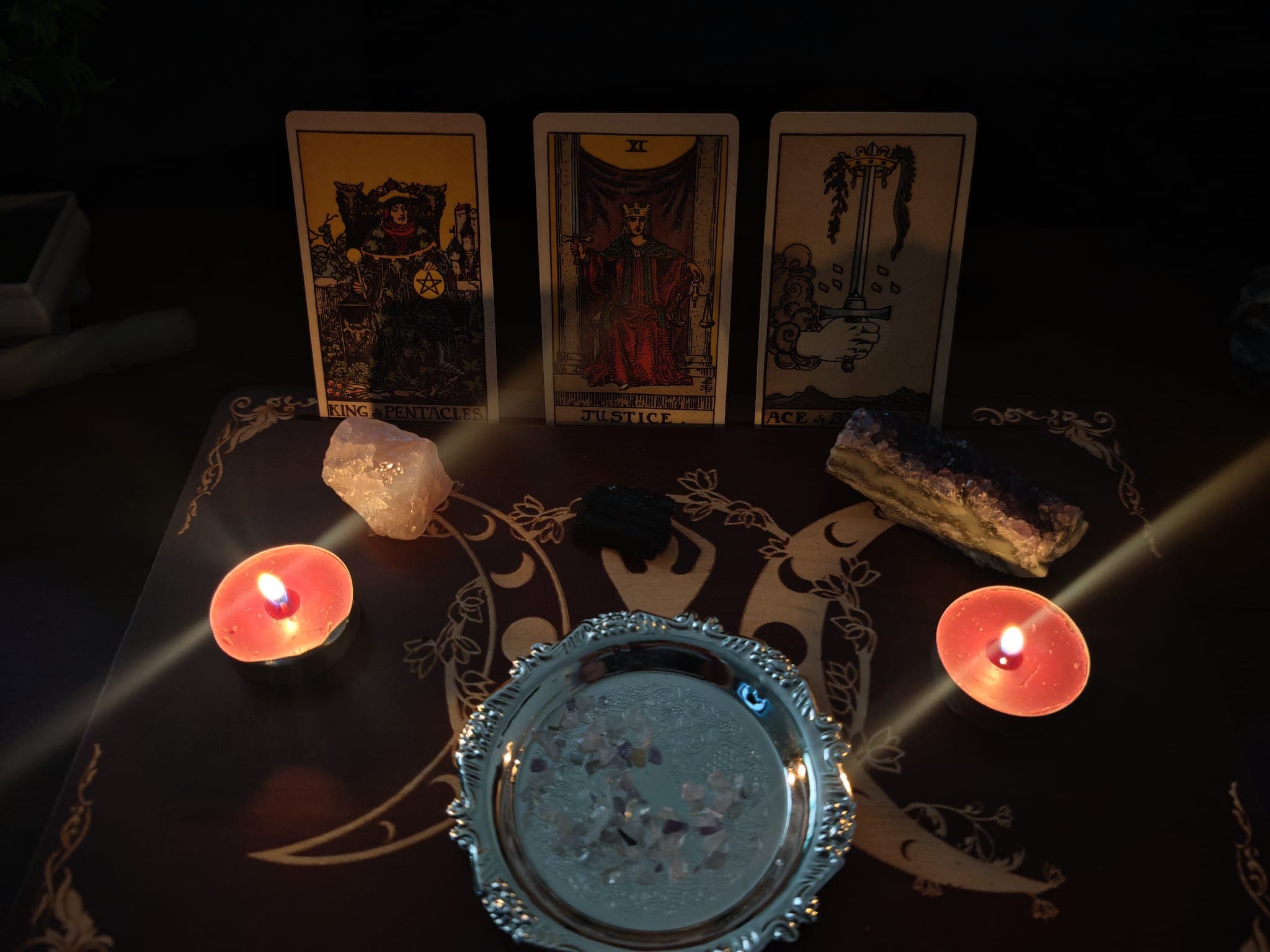
In a 3-Card Reading (22 EUR), Bartłomiej lays three cards from a real Rider-Waite-Smith deck and names the truth that is trying to get through in your situation. You receive a photo of the actual spread and a written interpretation on a private link, plus one free follow-up question within 48 hours.
Order a 3-Card Reading →