What a birth chart shows
A birth chart records celestial positions for a particular time and location, displayed through astrological signs and houses. The positions can be calculated astronomically. Astrology reads them as a map of the character and potential you were born with.
Our free birth chart calculator shows ten celestial bodies, the Ascendant, houses and five major aspect types. It uses the tropical zodiac. A sidereal calculator can place the same planet in a different sign, so check this setting before comparing results.
The data you need
Use your birth date, the local time recorded in your documents and your birthplace. Do not convert the time to UTC yourself. The calculator uses the city's time zone and the available historical clock-change rules.
- Select a city from the results rather than leaving unselected text in the search field.
- For a small place, enter coordinates and an IANA time zone manually.
- When clocks move back in autumn, some times occur twice. Check your records before choosing the earlier or later occurrence.
- For older dates, historical local time rules may need additional verification.
Sun, Moon and rising sign: three different questions
Astrologers associate the Sun with identity and self-expression, and the Moon with emotions and everyday needs. The Ascendant is the point of the ecliptic rising on the eastern horizon. Symbolically, it describes how you approach the world.
You do not need to select one description as the true one. Treat these as three themes to reflect on. Select a planet on the wheel to see its sign, degree and, when the time is known, its house. Ask what feels familiar rather than trying to fit your entire life into one sentence.
Why house systems change a chart
The twelve houses organize areas of interpretation, from identity and resources to relationships, public life and solitude. Their boundaries depend on the system. Whole Sign begins the first house at the start of the Ascendant's sign. Equal houses begin at the Ascendant's exact degree, with each house spanning 30°.
Tarovia supports both systems, but does not calculate Placidus houses. If another calculator shows a different house for a planet, compare house system, zodiac, time and time zone first. A different house does not necessarily mean the planet position is wrong. At latitudes of 66° or more, this calculator omits the Ascendant and houses.
What the lines inside the wheel mean
An aspect is an angular relationship between two planets. We show conjunctions at 0°, sextiles at 60°, squares at 90°, trines at 120° and oppositions at 180°. The orb measures the deviation from the exact angle. Our maximum is 6°, or 4° for sextiles.
Symbolically, aspects describe how the planets' themes interact. Avoid dividing the chart into good and bad lines. A square is friction that builds strength, and a trine is a gift that still has to be used. Start by identifying the two planets connected by the line.
If you do not know your birth time
Select the unknown-time option. The calculator uses local noon and hides the Ascendant and houses instead of guessing them. The Moon moves fast enough that its degree, and sometimes its sign, depends on the hour. Its aspects may also differ.
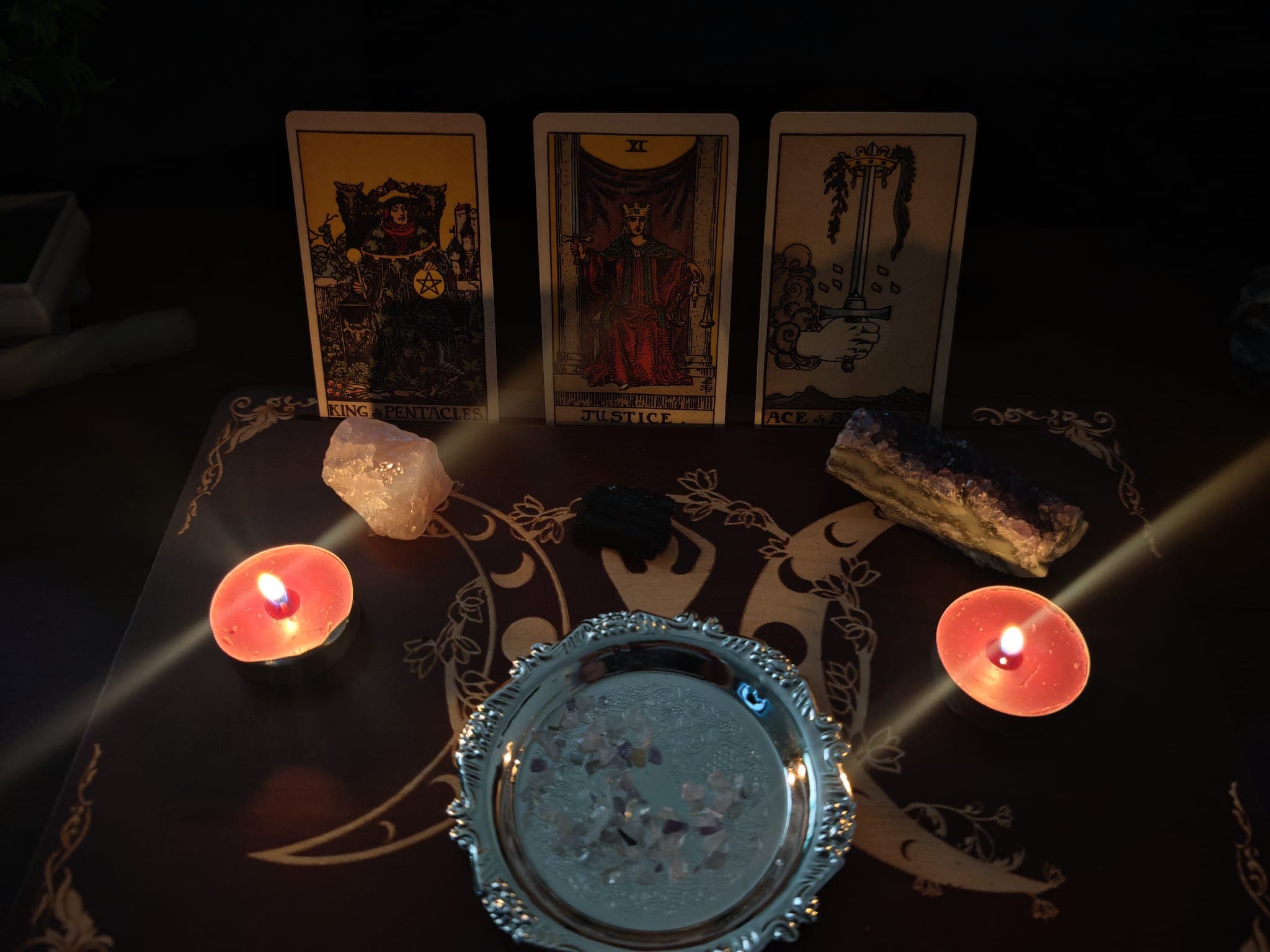
This gives you a starting point for exploring symbolism, not a fully timed chart. If you want to explore a specific current situation, you can separately choose a personal tarot reading. It is a different practice, built around your question and a physical card spread.
Frequently asked questions
Is my zodiac sign enough for a birth chart?
No. Planet positions need a date and time; the Ascendant and houses also need a location. Your Sun sign is only one part of the chart.
Does this chart predict my future?
Our calculator shows your natal positions with their core meanings, a solid starting point for deeper chart work.
Personal reading
Explore your map of the sky
Calculate planet positions, choose a house system and select chart elements to explore their meanings. No account or email required.
Open the free birth chart →